Dispatch
Choosing the Right Guitar For You
Are you thinking about learning guitar or searching for a new instrument to add to your collection? That’s exciting! Learning to play guitar can be an incredibly enjoyable and fulfilling hobby. Before you start learning your favorite songs, however, you need to find an instrument that suits you.
Elliot Parker
Rider
Desk note
Full dispatch and transfer tips sit below.
Line
Blue Line Walk
Are you thinking about learning guitar or searching for a new instrument to add to your collection? That’s exciting! Learning to play guitar can be an incredibly enjoyable and fulfilling hobby. Before you start learning your favorite songs, however, you need to find an instrument that suits you.
With countless guitar models, styles, and price points available, choosing one can initially seem confusing. Fortunately, the process becomes much easier when you know which factors deserve the most attention. From your spending limit to the kind of music you want to play, a few basic considerations can help you find an instrument that feels right.
Set Your Price Range
Guitars are available at almost every price level. Some beginner instruments can cost around $100, while high-end models can reach $10,000 or more. Establishing your budget before you start shopping will help you focus on instruments that are realistic for you.
If you are just starting out, there is no need to spend a huge amount of money. A good-quality secondhand guitar can sometimes provide excellent value and give you more instrument for your budget. However, there is also something special about owning an instrument that feels completely like your own.
Whatever amount you decide to spend, try to choose the best-quality guitar you can reasonably afford. A well-made instrument can be more enjoyable to play and may encourage you to keep practicing.
Match the Guitar to Your Musical Style
After deciding how much you want to spend, think about the kind of music you hope to play. Your musical interests should have a major influence on the type of guitar you choose.
The two main categories are acoustic and electric guitars. Acoustic guitars are particularly well suited to folk, country, and singer-songwriter music. They produce a naturally warm and resonant sound and can be played without connecting to an amplifier.
Electric guitars are commonly associated with rock, blues, and metal. They generally produce a sharper and more powerful tone and need an amplifier to produce their full sound.
Your choice should not depend entirely on musical genre, though. The guitar also needs to feel comfortable in your hands. Pay attention to the instrument's size, shape, neck, and overall playing feel before making your decision.
Electric Guitars Can Be Easier for Beginners
Many people assume that acoustic guitars are automatically easier for new players, but that isn't necessarily the case. In fact, electric guitars can sometimes be more comfortable for beginners.
Electric guitar strings are generally thinner and are held under less tension than acoustic guitar strings. As a result, pressing the strings against the fretboard usually requires less force.
For a new player whose fingers are still developing strength and coordination, this can make the first stages of learning feel somewhat easier.

Pick an Instrument That Inspires You
When I talk with students and parents about buying a first instrument, I often emphasize one factor above everything else: you should genuinely like the guitar you choose.
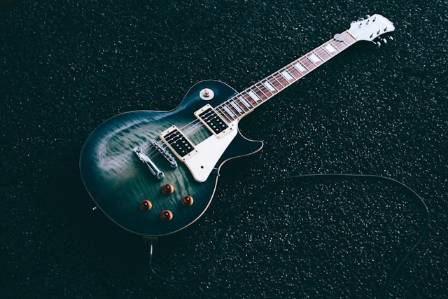
Appearance may sound less important than technical specifications, but an instrument that catches your eye can provide valuable motivation. Imagine seeing your guitar sitting on a stand in your living room and immediately wanting to pick it up and play a few chords. That kind of attraction can encourage you to practice more often.
And the more frequently you play, the more comfortable you become with the instrument. Regular practice leads to greater skill, which eventually helps you develop confidence and your own musical style.
Choose a Guitar You Want to Play
Selecting a guitar does not have to be overwhelming. Start by establishing a realistic budget, then consider the music you want to learn and the type of guitar that best suits that style. Most importantly, make sure the instrument feels comfortable and genuinely appeals to you.
The best guitar is not necessarily the most expensive or technically impressive model. It is the one that makes you want to pick it up and play.
Once you find an instrument that feels right, you can begin learning the songs you love, developing your technique, and eventually creating a sound that is uniquely yours.